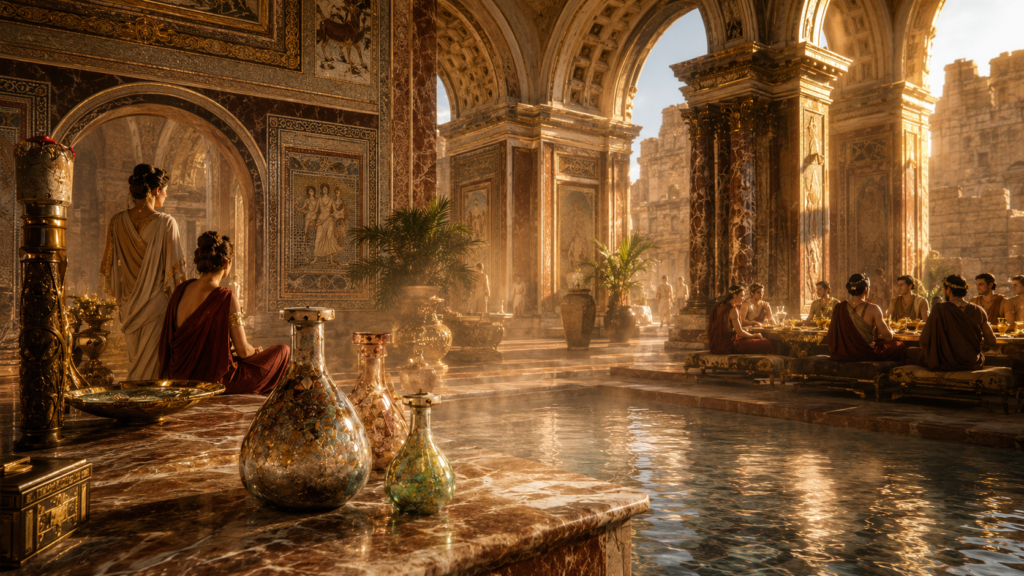
Long before luxury hotels, private spas and curated experiences, the Romans had already transformed pleasure into architecture, ritual and spectacle. In imperial Rome, bathing was no longer simply a matter of hygiene. It became a social experience, a public ritual and, at times, a powerful statement of prestige.
The Architecture of Pleasure
The great imperial baths, such as the Baths of Caracalla and the Baths of Diocletian, turned water, heat, marble and engineering into monumental settings for leisure, conversation and civic life. They were not just places to wash. They were vast multifunctional complexes where people could bathe, exercise, stroll, study, relax and take part in the rhythm of the city.
The engineering behind this culture of pleasure was extraordinary. Through the hypocaust system, hot air produced by furnaces circulated beneath raised floors and through wall ducts, heating entire rooms. Spaces such as the caldarium, tepidarium and frigidarium offered different temperatures, creating a sensory journey that feels surprisingly close to the modern idea of wellness. The Baths of Diocletian alone covered around 13 hectares and could accommodate up to 3,000 people at one time, while the Baths of Caracalla remain one of the largest and best-preserved thermal complexes of antiquity.
Baiae: The Submerged Sanctuary of Otium
Among the most seductive expressions of Roman leisure was Baiae, on the Bay of Naples. Celebrated for its mild climate, beautiful landscape and thermal waters, Baiae became one of the favorite retreats of the Roman aristocracy and imperial family. Villas, bath complexes and waterfront residences shaped a landscape of otium, privilege and power.
Over the centuries, part of that world was submerged by the sea due to bradyseism. Today, the Underwater Archaeological Park of Baiae preserves remains of domus, villas, spas, mosaics and statues beneath the surface of the water. It is one of the most powerful images of Roman luxury: not something loud or obvious, but an entire civilization of refined living silently preserved by the sea.
The Banquet as a Private Stage
If the baths represented the luxury of the body and public life, the banquet was the luxury of the private stage. For the Roman elite, hosting guests was never simply about offering a meal. A banquet was a carefully staged social performance, designed to display wealth, taste, influence and refinement.
Dining rooms, known as triclinia, were decorated with mosaics, wall paintings and stucco reliefs. Guests reclined on couches arranged around the table, while the host impressed them with rare foods, precious tableware and forms of entertainment intended to delight both the eye and the ear. Music, poetry, acrobats and performance could accompany the feast. The meal became spectacle.
The Language of Elegance
Beauty and self-care were part of the same culture of refinement. Men and women of high Roman society surrounded themselves with jewelry, silver mirrors, ivory combs, hairpins, perfumes, oils and cosmetics. Small glass vessels held scents, ointments and beauty products used in daily life. The body, its fragrance, its adornment and its presentation were not secondary details: they were part of a broader language of elegance and status.
What survives today is not only a collection of ruins. It is the memory of a way of living. Warm rooms, monumental pools, seaside villas, frescoed dining spaces, theatrical banquets, precious objects and rituals of beauty reveal a Rome that had already understood something deeply modern: luxury is not only possession. It is experience.
Perhaps this is why luxury feels so natural in Rome. It is not a recent invention, nor an ornament created for contemporary travelers. It belongs to the city’s oldest memory — to its stones, its waters, its rituals and its timeless art of living well.