



Tarquinia – An experiential journey into the volcanic heart of Latium, where thousands of years ago grapevines were cultivated in a unique way and joyfully celebrated. Discover an ancient legacy of equality, history, and sacred traditions.
A must-visit territory to discover the roots of Rome and to taste and experience the unique Etruscan wine and history when in Rome.
To truly understand the soul of Rome, one must venture beyond its classic marble monuments and delve into the fertile, volcanic earth of Latium.
Thousands of years ago, long before the rise of the Roman Empire, an enigmatic and sophisticated civilization cultivated these very soils, establishing the foundations of Mediterranean art, luxury, and viticulture: the Etruscans.
A short trip from the capital you can immerse yourself into the historic territory of Southern Etruria and discover the archaeological wonders of Tarquinia and an elite multi-sensory enotourism.
Did you know ?
The Etruscans were the true founding fathers of viticulture in Central Italy. Between the 8th and 4th centuries BC, wine production and maritime trade constituted their primary source of wealth and cultural prestige in the Mediterranean and throughout part of the peninsula. But more than an industry, wine here was an art form, a sacred tradition, and a joyful celebration of life that continues to echo through the centuries into the modern glass.
The Sacred Viticulture: “Vite Maritata”
Thousands of years ago in Latium, grapevines were cultivated in a unique, breathtakingly poetic way. Unlike modern vineyards characterized by neat, low-lying rows, the Etruscans viewed viticulture as a sacred partnership with nature, pioneering a cultivation method based on absolute symbiosis:
- Arboreal Symbiosis: The Etruscans did not plant vines in isolated rows. Instead, they trained the grapevines to climb living support trees, traditionally elms or poplars, letting the vineyard grow toward the heavens.
- Agro-Biological Protection: This raised architecture lifted the precious grape clusters high above the ground, effectively shielding them from soil-born moisture, frost, and terrestrial pests.
- An Enduring Legacy: Known historically as “vite maritata” (married vine), this dramatic and picturesque canopy system survived for millennia across Central Italy, shaping the rural landscape until the mid-20th century.
The Symposium, Joyful Celebrations, and the Liberated Etruscan Woman
Wine consumption was elevated to its highest expression during the banquets and symposia that stood at the very core of social, political, and spiritual life in Etruria. These gatherings were not rigid rituals, but joyful celebrations of abundance, music, and freedom.
In essence, revolutionary contrast to the conservative customs of ancient Greece and later Rome, where respectable women were strictly excluded from public life and forbidden from drinking, instead the Etruscan society celebrated gender equality.
Etruscan women participated fully and actively in the symposia. They reclined elegantly on luxurious banquet couches (triclinia) alongside men, engaged in intellectual discourse, toasted freely, and held a position of high social reverence. The “Etruscan Vine” was a culture where women and wine shared a shared legacy of freedom and prestige, a vibe of sophisticated indulgence that defines Italian hospitality to this day.
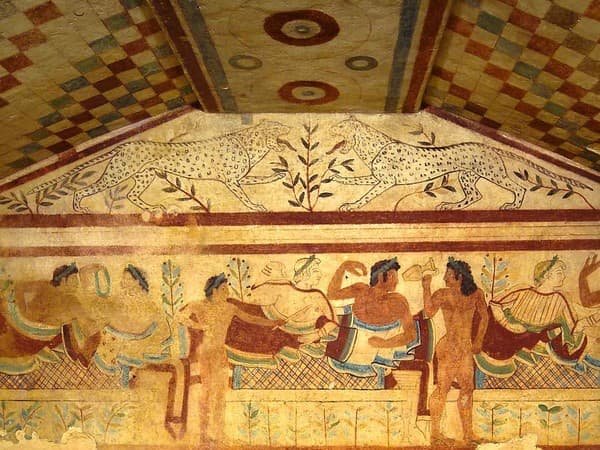
An Ancestral Taste: Wine in the Ancient Era
The nectar enjoyed at these liberating Etruscan banquets reflected a palate that prized density, intensity, and complex preservation techniques.
Etruscan wine was remarkably dense, robustly alcoholic, and carried a potent, unfiltered flavor profile. It was never consumed pure; instead, it served as a base for elaborate preparations, diluted with fresh water, or even purified seawater and masterfully infused with local honey, aromatic pine resins, wild spices, crushed flowers, and grated aged cheese.
To preserve this precious liquid, it was stored within massive clay jars known as pithoi. The interiors of these vessels were meticulously coated with wild pine resin, which acted as an impermeable barrier while imparting a distinct, balsamic character to the vintage.
The Maritime Wine Trade Across the Mediterranean
Fueled by their exceptional agricultural surplus, the Etruscans transformed themselves into formidable maritime merchants, dominating the trade routes of the Western Mediterranean.
They exported their signature vintages across the seas, establishing elite trade networks particularly with Southern Gaul (modern-day France), effectively introducing fine wine consumption to regions now famous for their own viticulture. Today, marine archaeologists routinely discover thousands of ancient Etruscan transport amphorae on the Mediterranean seabed, instantly recognizable by their distinct, elegantly tapered pointed bases.
The Botanical Archeology: Genetic Descendants of Etruria
Modern DNA profiling of Italian grapevines has unlocked a fascinating truth: the soul of Etruscan viticulture lives on inside your glass. Contemporary varietals in Central Italy preserve a direct genetic and cultural lineage to vines domesticated over 2,500 years ago from the wild Vitis vinifera sylvestris.
Direct Genetic Heirs
- Lambrusco: Directly named after the Latin labrusca (wild vine), its forest-born ancestors were selectively bred by Etruscan farmers in ancient woodlands.
- Sangiovese & Ciliegiolo: Germplasm analysis confirms these premier red varieties stabilized in the Etruscan heartland during antiquity.
- Greco di Tufo & Aglianico: Though celebrated in Southern Italy, their original cultivation models stem directly from Etruscan agricultural expansion.
The Modern DOC Tarquinia
Today, the historic territory of Tarquinia safeguards this millennial tradition through a dedicated DOC, utilizing native varieties that embody the essence of Southern Etruria:
- Procanico (Trebbiano Toscano): The foundational white grape of the region, delivering brilliant freshness and a signature volcanic minerality. It is considered the Etruscan grape par excellence (originally called Trebula).
- Grechetto: Widespread between Umbria and Lazio, it produces structured, savory whites that closely mirror the profiles praised by ancient writers.
- Malvasia (Lazio & Toscana): Aromatic grapes that infuse local white blends with structure and intense floral bouquets.
- Aleatico: An aromatic red variety perfect for dense, sweet dessert wines, perfected by the Etruscans centuries ago.
- Montepulciano, Sangiovese & Canaiolo: The robust structural backbone for Tarquinia’s finest reds and vibrant rosés.
Sensory Profiles from Volcanic and Tufaceous Terroirs
The exceptional organoleptic profiles of the Tarquinia DOC are forged by the region’s unique terroir: nutrient-rich volcanic soils, ancient tufa stone layers, and the cooling maritime breezes sweeping in from the Tyrrhenian Sea.
- Tarquinia Bianco: Brilliant straw-yellow. The bouquet is delicate, airy, and fruit-driven, bursting with crisp green apple, white peach, and wild fields of flowers. On the palate, it is bone-dry, savory, and remarkably fresh, closing with an unforgettable mineral and saline finish driven by the coastal volcanic soil.
- Tarquinia Rosso: Deep ruby red, gracefully evolving to garnet with age. It reveals an intense, persistent aroma dominated by ripe forest fruits, sour cherry, blackberry, and wild plum, woven with elegant, warm spices. It is full-bodied, velvety, and well-structured, featuring beautifully polished tannins for a clean, dry finish.
- Tarquinia Rosato: A vivid, luminous cerise pink. It offers a fragrant sensory experience rich in small red berries, wild raspberries, and delicate hints of rose petals. Harmonious and fluid, it perfectly balances the vibrant, crisp acidity of a white wine with the light structural elegance of a red.
Technical Mastery: Sparkles and Sweetness
Governed by strict production codes (Disciplinare di produzione), the Frizzante (sparkling) and Amabile (semi-sweet) variants of the Tarquinia DOC showcase the technical versatility of these ancestral grapes, maintaining precise analytical parameters:
Tarquinia DOC Bianco Frizzante
Crafted to maximize the vibrant, crisp energy of Trebbiano and Malvasia.
- Ampelographic Base: Trebbiano Toscano & Trebbiano Giallo (minimum 50%); Malvasia bianca di Candia & Malvasia del Lazio (maximum 35%).
- Minimum Alcohol: 10.50% vol.
- Minimum Total Acidity: 4.5 g/l | Net Dry Extract: 14.0 g/l.
- CO₂ Pressure: 1 to 2.5 bar at 20°C from natural secondary fermentation.
- Sensory Profile: A fine, fleeting mousse with a lively, smooth palate and a pleasantly soft finish.
Tarquinia DOC Bianco Amabile
The ultimate balance between intense territorial salinity and soft residual sweetness.
- Minimum Total Acidity: 5.0 g/l (Enhanced acid structure ensures the wine remains remarkably crisp and never cloying).
- Residual Sugar: Perfectly balanced between 30 and 50 g/l.
- Sensory Profile: Luminous straw yellow, intensely fruity nose, and a beautifully velvety taste framed by an excellent acidic backbone.
Tarquinia DOC Rosso Amabile
A highly revered local historic tradition, marrying red structure with sweet, velvety smoothness.
- Ampelographic Base: Sangiovese & Montepulciano (minimum 60%); Cesanese Comune (maximum 25%).
- Net Dry Extract: 18.0 g/l (reflecting the deep polyphenol structure of the red skins).
- Residual Sugar: 30 to 50 g/l.
- Sensory Profile: Deep ruby; vinous and berry-rich aroma; full-bodied, smooth, and lush with perfectly rounded tannins.
Gastronomic Alchemy: Perfect Pairings from the Tuscia
To experience these wines to their fullest, one must pair them with the robust, traditional culinary treasures of the Tuscia region (the territory of Viterbo and its surroundings), allowing the mineral properties of the earth to complement bold regional flavors.
With Tarquinia Bianco (Still or Frizzante)
The high acidity and sea-salt mineral notes cut effortlessly through rich textures, pairing spectacularly with freshwater fish and local sheep cheeses.
- Coregone del Lago di Bolsena: Grilled or prepared “alla bolsenese” with fresh herbs. The crispness of the white wine perfectly cleanses the palate from the delicate oils of this local lake fish.
- Pecorino Romano DOP or Tuscia Pecorino: Medium-aged variants. The wine’s structural salinity beautifully counterbalances the sweet, fatty core of the cheese.
- Acquacotta Viterbese: A historic peasant soup of wild chicory, potatoes, poached egg, and stale crusty bread. The Frizzante variant refreshes the palate beautifully after every rich spoonful.
With Tarquinia Rosso
The structured, finely polished tannin matrix demands rich, savory, and deep meat dishes native to the ancient Etruscan hinterlands.
- Fagioli del Purgatorio di Gradoli with Pork Rind: A rich, succulent stew of local white beans and pork. The bold tannins dry the palate, balancing the hearty proteins and legumes.
- Wild Boar Cacciatore or Jugged Hare: Rich wild game stews find their ultimate match in the dark berry notes and peppery spices of this volcanic red.
- Porchetta di Vallerano or Tarquinia: Savory slow-roasted whole pork heavily seasoned with wild fennel and black pepper. The warmth and body of Sangiovese and Montepulciano slice beautifully through the rich fat.
With Tarquinia Bianco or Rosso Amabile
The exquisite 30 to 50 g/l residual sugar requires dessert elements that match its flavor intensity or sharp, contrast-driven savory elements.
- Tozzetti di Viterbo: Traditional hard biscotti packed with local Roman gently-roasted hazelnuts from the Cimini Mountains. Tarquinia Bianco Amabile mirrors the sweetness without masking the hazelnut aroma.
- Frittelle di Tarquinia: Festive Carnival or Christmas fritters accented with aniseed or cauliflower. The sweet style cuts through the fried richness and complements the aromatic anise notes.
- Artisanal Blue Cheeses or Extra-Aged Pecorino: A breathtaking finale. The rich sweetness of Tarquinia Rosso Amabile tames the sharp, pungent bite of complex aged cheeses.
Frequently Asked Questions (FAQ)
1. What made Etruscan wine unique compared to modern wine? Etruscan wine was much denser, highly alcoholic, and heavily textured. It was never drunk pure; it was mixed with water (sometimes seawater) and aromatized with honey, resins, spices, and flowers. It was aged in large resin-coated clay pots called pithoi, giving it a unique balsamic note.
2. How did the “Vite Maritata” cultivation method work? The Etruscans did not use modern vineyard rows. Instead, they used a symbiotic system where grapevines were trained to climb living trees like elms or poplars. This protected the grapes from ground pests and humidity, ensuring healthy fruit high above the soil.
3. What role did women play in Etruscan wine culture? Unlike in ancient Greece or Rome, where women were excluded from public drinking and banquets, Etruscan women enjoyed high social status and equality. They actively participated in symposia, reclined on banquet couches alongside men, and drank wine freely, turning the banquet into a joyful celebration.
4. Which modern grapes are directly related to Etruscan history? Grapes like Trebbiano (originally called Trebula) and Grechetto are historic white varieties of Central Italy. Red grapes like Sangiovese, Lambrusco (from the wild labrusca), and Aleatico possess deep genetic or cultural links to the ancient selections made by the Etruscans.
Etruscan Wine Glossary
- Amabile: A wine term indicating a medium-sweet or semi-sweet profile, typically containing between 30 and 50 grams of residual sugar per liter.
- Amphora: A two-handled ancient clay container with a tapered or pointed base, used by the Etruscans to transport wine across maritime Mediterranean trade routes.
- Pithoi: Very large, wide-mouthed ancient earthenware storage jars used for bulk fermentation and preservation of wine, coated internally with pine resin.
- Symposium: A highly ritualized ancient banquet focused on communal wine drinking, intellectual conversation, music, and social bonding.
- Triclinium: A formal dining layout consisting of three luxurious reclining couches arranged around a central table, utilized during elite ancient banquets.
- Vite Maritata: Literally “married vine,” an ancient cultivation technique where a grapevine is physically trained to grow up the trunk and branches of a living host tree.
- Vitis vinifera sylvestris: The ancestral, wild Eurasian grapevine species from which modern wine grapes were selectively domesticated by ancient civilizations.
The yearly event in the city dedicated to the Etruscan wine is called Divino ( Divine) and it take place towards the end of August, a week long event with local street food and a couple dozen different representatives of the Eturian cities of the Tucia come to compete and expose their best produce in a happy and friendly atmosphere full of music and authentic Italian country lifestyle event with a unique artistic ancestral twist to it, absolutely one of a kind experience.
